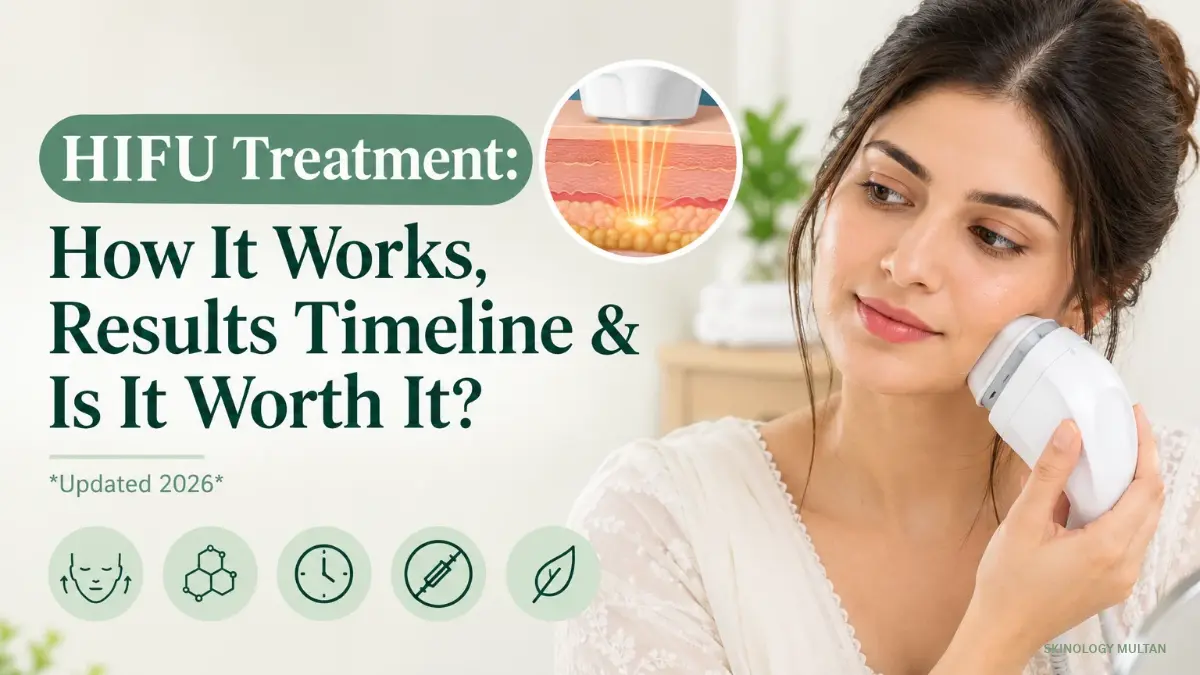
HIFU or High-Intensity Focused Ultrasound is a type of nonsurgical procedure which employs the use of highly concentrated sound waves to raise temperature of underlying skin tissues, causing new collagen formation and leading to lifting and tightening of the skin.
How HIFU actually works
While lasers work on the surface level, the energy from HIFU therapy focuses at a certain depth, which is usually the same level of the connective tissue that a surgeon lifts up when performing a facelift — SMAS (superficial musculoaponeurotic system). It is the layer under the skin and fat that provides the structure of your face; the tissue that gets loose with aging skin and is lifted surgically during a facelift.
The energy from ultrasound pulses heats the tissues at the required depth (about 60-70° C), which destroys the old connective tissue fibers without damaging the skin surface. The body then responds to this damage by producing new collagen fibers.
Does HIFU actually work? What the evidence says
It is at this point that there must be a distinction between mechanisms and evidence, because knowing how it works does not mean it works in reality.
There is a systematic review in 2025 in the Aesthetic Surgery Journal, which reviewed 45 clinical studies, revealing that HIFU was significantly effective in skin tightening, especially the lower part of the face, neck, and periorbital region, with skin laxity reduction by 18 to 30%. Earlier studies showed 80% physician rating of improvement in facial and neck skin of those who were treated, while 78% were satisfied with their treatment.
However, one thing to remember from the studies: it can only help with mild to moderate skin laxity and not advanced loose skin. It tightens the skin but cannot remove extra skin.
What HIFU can and can't improve
HIFU is commonly used for:
- Jawline definition and softened jaw contours
- Under-chin and neck laxity (“turkey neck”)
- General facial firmness and early jowls
- Brow lifting and periorbital tightening
- Fine lines linked to skin laxity (not deep wrinkles)
HIFU does not:
- Remove significant excess skin (that needs surgery)
- Primarily reduce fat (any fat change is a minor secondary effect, not the main mechanism)
- Produce an instant result — any immediate tightening you notice is a temporary tissue response, not the real result
Results timeline: what to actually expect
Usually one treatment is sufficient for mild to moderate laxity; advanced conditions may require another treatment several months later. There is no universal regimen, as it depends on the state of your skin and your body’s ability to generate collagen.
Is HIFU right for you? Quick self-check
You’re likely a reasonable candidate if:
- You’re noticing mild-to-moderate sagging (not significant loose skin)
- You want to avoid surgery, injections, and downtime
- You’re prepared for gradual results over 2–3 months, not instant change
- You’re in general good health with no active skin infections in the treatment area
It is advisable that you discuss with a doctor first if you are pregnant, breastfeeding, suffer from skin laxity, or have metal implants on your face. You can also consult the doctor if you have had keloids before to be sure whether HIFU is right for you.
HIFU vs. Botox vs. RF vs. thread lift
They are not competitive therapies but rather tools that serve different purposes; in fact, HIFU and Botox therapy can be combined often, because while HIFU targets sagging, Botox works to eliminate expression lines.
Side effects and safety
However, most of the side effects that are experienced are mild, and they only last for a couple of days after the procedure. Some studies indicate that pain occurs in around a quarter of the patients who receive treatment and goes away spontaneously.
However, major complications are quite uncommon and there is absolutely no scientific proof linking HIFU to cancer since it uses sound waves energy and not radiation.
This makes experience of the practitioner very important when it comes to HIFU treatments.
Aftercare basics
• Apply a sunscreen SPF 30+ everyday because UV rays might disrupt your recovery process
• Do not use a sauna, very hot shower, or engage in vigorous activities for one to two days
• Retinol and harsh peels should be avoided in the affected region for up to seven days
• Alcohol should not be used within at least two days due to increased swelling
• Your regular activity is possible right away; there is no downtime
Is HIFU right for your skin?