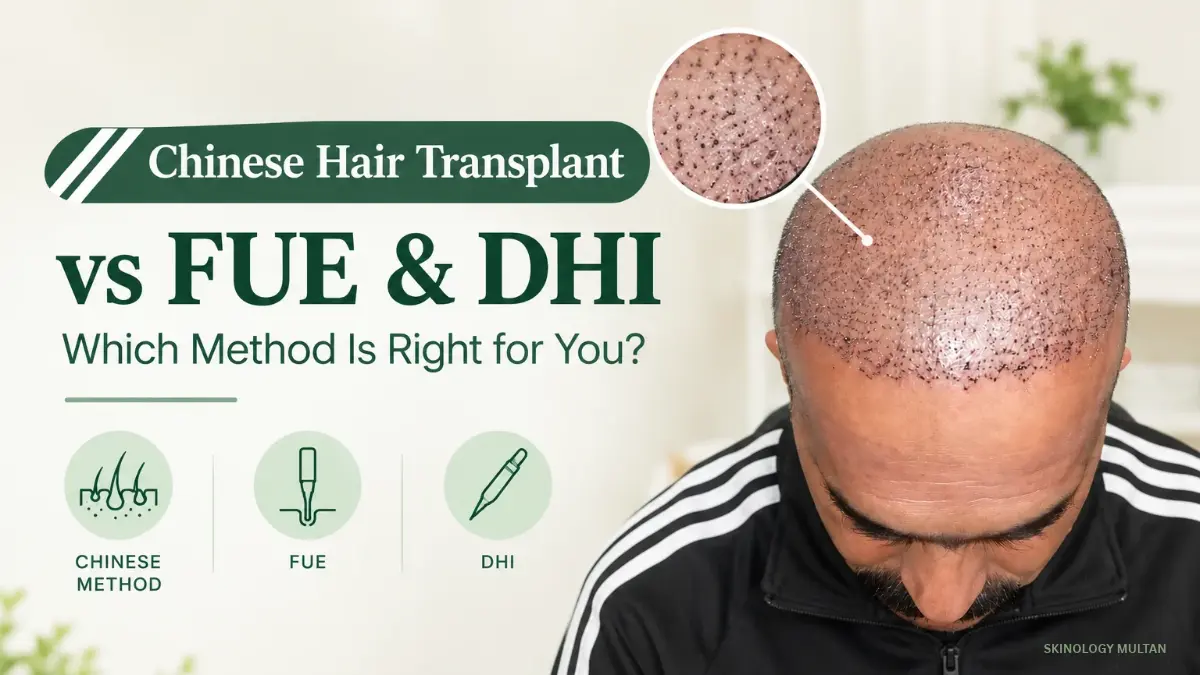
If you’ve been scrolling Facebook or YouTube, you’ve probably seen clinics advertising the “Chinese Method” hair transplant, often next to a photo of thousands of grafts packed into one session. It sounds like a brand new technology. Here’s the honest answer: it isn’t.
“Chinese Method” is not a recognized medical technique. There’s no textbook, no surgical board, and no research journal that defines it. It’s a marketing name, usually used to describe regular FUE done with a certain brand of punch or implanter pen, or done at a very high graft density. That doesn’t mean it’s a scam. It just means the name tells you nothing about the actual surgery you’re getting.
At Skinology Laser & Aesthetics in Multan, we’d rather tell you what’s really happening under that name than sell you a label.
What Clinics Are Actually Doing When They Say "Chinese Method"
Once you remove the label, all that’s left is a standard FUE process:
The doctor evaluates your scalp, the donor area, and the extent to which your hair loss has gone on.
Each hair follicle is extracted from the donor site one by one.
- Those follicles are sorted and kept safe while they’re outside the body.
- They’re placed into the bald area, either by hand with forceps or with a pen-style implanter.
- Your scalp heals over one to two weeks, and the real results show up slowly over six to twelve months.
That’s FUE. Some clinics using this name are using Chinese-made punches or implanter pens. Others are just placing grafts closer together and calling it “super dense.” Neither of those things is a new surgery — they’re details inside an existing one.
Chinese Method vs FUE vs Sapphire FUE vs DHI
The name on the package doesn’t change any of these numbers. Two clinics can both say “Chinese Method” and be doing completely different things — one careful and well-planned, one just packing in grafts to look impressive in a before/after photo.
The only way to know which one you’re walking into is to ask direct questions, covered below.
Does It Actually Give You More Hair Density?
Some clinics show off photos with 4,000, 5,000, even 8,000+ grafts in one sitting and call that the Chinese Method’s special power. More grafts can look dramatic in a photo. It is not automatically better for you.
Your results depend on:
- How many healthy donor follicles you actually have
- How thick your hair shaft is
- Blood supply to your scalp
- How carefully grafts are handled outside the body
- In case you are suffering from progressive hair loss
Overpacking of hair follicles can limit the blood flow to the region thereby reducing chances of survival. A high graft number sounds good on camera. It isn’t the same thing as a good result a year later.
Is It Safe for Pakistani and Asian Hair Types?
Pakistani and Asian hair is generally thicker and straighter and grows at a different angle from European hair. If a surgeon is impatient with the extraction process or uses improper punch sizes, you’ll have gaps in the donor area, or a weird appearance when viewed from the front.
This doesn’t matter about any “Chinese” or “Turkish” labeling — it depends on whether the doctor knows what he’s dealing with.
Chinese Method Hair Transplant Cost in Multan (2026)
Here’s no fixed “Chinese Method price,” because there’s no fixed Chinese Method. What you pay depends on:
- How many grafts you need
- How complex your hair loss pattern is
- Which instruments the clinic uses
- The surgical team’s experience
- Aftercare included in the package
Be careful with any clinic that gives you a price over the phone or from a Facebook post before even seeing your scalp. A real quote comes after a real assessment. At Skinology, we look at your donor area and goals first, then give you a graft-based estimate you can trust.
How to Tell If a Clinic Is Doing This Right
When looking for something called the Chinese Method, here are the questions to ask at the consultation:
If a clinic cannot give you a clear answer or starts becoming defensive, there is your answer.
- Who will be conducting the surgery – a dermatologist or a surgeon, or a technician
- Which extraction method do they use and why?
- Can they provide before-and-after pictures of people with hair similar to yours?
- How would they approach a situation where you need the second procedure?
- Would a doctor stay with you throughout the procedure and not just for the beginning?
Which Method Fits Your Situation?
- Receding hairline: needs careful hairline design, not just high density up front.
- Crown baldness: the crown’s spiral pattern needs a planned approach, not dense packing.
- Extensive baldness: your donor area needs protecting for the future, not maxing out today.
- Early hair loss: medical treatment may make more sense before any surgery.
- Women with thinning hair: needs a proper diagnosis first; not every case is a transplant case.